2026 CodeforAwhile: Data for Good AI Challenge for Middle and High School Students
Empowering Middle and High School Students to Solve Real-World Problems with AI
Dates: March 28 and 29, 2026
Location: The Link, 425 Town Plaza Ave, Ponte Vedra, FL 32081
Join the AI for Good community to develop technology that matters. Code with purpose, collaborate with a diverse network of peers, and leverage AI-driven innovations to engineer analytically-grounded solutions that create sustainable, real-world impact.
Registration closed. This datathon has ended!
Unleash Your Data Power:
Compete with Your Peers and Make an Impact in Florida!
Are you passionate about Science and Technology?
If you are a middle or high school student in Duval or St. Johns Counties in Florida, this is your chance to shine! The 2026 CodeforAwhile Datathon is an exciting in-person event designed just for you.

Why Participate?
| Build Your Skills in the Age of AI |
Build Your Skills in the Age of AI: Dive into the world of data science and master the intersection of human logic and artificial intelligence. Enhance your problem-solving abilities by leveraging Generative AI for rapid coding, automated data synthesis, and advancing your analytical depth to stay ahead in an AI-driven landscape. |
|---|---|
| Network with Peers and College Students |
Network with Peers and College Students: Connect with fellow students who share your passion for data science and gain valuable insights from experienced college mentors. Receive personalized feedback from UNF Computing student mentors to enhance your work on critical phases of the AI competition, including problem understanding, data preparation, and data analytics. |
| Learn by Doing |
Learn by Doing: Tackle real-world data science challenges using curated datasets designed by UNF Computing Professors. These challenges are perfect for practicing AI-driven problem solving, giving you hands-on experience with developing practical, data-centric solutions. |
| Gain Recognition |
Gain Recognition: Stand out in your college applications by showcasing your dedication to going beyond the classroom. The top three winning teams will receive prizes, earning well-deserved recognition for their outstanding skills. A panel of industry leaders will judge the competition, evaluating the presentations made by students to determine the winning teams. |
Data4Good AI Participants
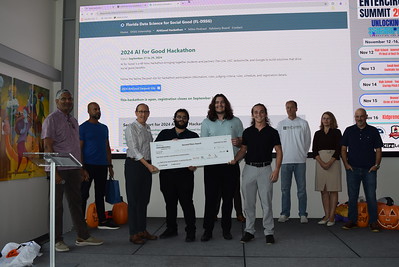
Over the course of a weekend, students from 3 middle schools and 5 high schools in Duval and St. Johns Counties worked on unique problems impacting the State of Jax initiative by the City of Jacksonville. Students were provided with the tools, support, and data needed so that they can write the code to right the world.
Hours
Middle School Students
High School Students
Teams
Participating students received mentorship from UNF School of Computing students and FL-DSSG faculty experts. Datathon participants were expected to form a team with a maximum of three to work on the datathon problems and datasets.
2026 CodeforAwhile AI for Good Datathon Problem Cases
In this competition, students were challenged to use real-world data to solve important problems in the City of Jacksonville and uncover interesting insights. Student teams were asked to choose one of two exciting problem cases and work together to analyze the data, find patterns, come up with solutions, and present them to a panel of judges.
Social Good Problem Cases
The 2026 Data4Good AI Challenge aligns closely with the goals of the City of Jacksonville's State of Jax initiative that was launched to highlight Jacksonville’s most pressing challenges and opportunities. By grounding datathon work in data-driven approaches, teams can contribute recommendations that directly support informed decision-making, equitable development, and the city’s broader mission of fostering thriving, inclusive communities. Hackathon participants were provided with three problem cases and expected to solve one of them.
Problem Case #1: Life Expectancy Gap
In Jacksonville, people living just a few miles apart can have life expectancies that differ by many years, largely depending on their ZIP code. These gaps often reflect unequal access to safe housing, good jobs, quality schools, transportation, and health care, which tend to cluster along lines of race and income. The core challenge is to pinpoint which neighborhood conditions are most tied to shorter lives and then design targeted, community-centered actions that can help every part of the city move toward longer, healthier lives.
Problem Case #2: Resource Deserts
In Jacksonville, some neighborhoods function as “resource deserts,” with limited access to grocery stores, health care, safe parks, and other essential services. These gaps often stem from long-term underinvestment and make everyday life more difficult, especially for low-income residents. The challenge is to pinpoint where these deserts are, understand how they worsen issues such as health and food insecurity, and design concrete actions that bring critical resources closer to communities that lack them.
Data Partner
Datasets relevant for the Data4Good AI challenge were obtained from mySidewalk through the partnership with the City of Jacksonville. Participants were provided with a primary set of datasets relevant to the life expectancy and resource desert problem cases. Participants were allowed to request additional data available in mySidewalk during the hackathon to enhance their analysis and AI solutions.
mySidewalk is a data platform that provides public data and intuitive tools for creating maps, reports, and visualizations to help communities, organizations, and government agencies make data-driven decisions. The platform integrates data from various trusted sources and offers templates for common needs, including demographics, housing, public health, and economic development.
2026 CodeforAwhile Data4Good AI Challenge Winners
Middle School Winners
First-Place Award
Team: Dare2Dream
School: Julia Landon College Preparatory and Leadership Development School
Team members: Divij Velagapudi, Advik Gupta, and Radhesh Sidda
Worked on Problem Case #1: Life Expectancy Gap
High School Winners
First-Place Award
Team: Elchay CF Script Writers
School: The Bolles School
Team members: Tudor Andrei Vlad, Gabriel Alvares de Azevedo, and Jake Kovacocy
Worked on Problem Case #1: Life Expectancy Gap
Second-Place Award
Team: Stanton 4
School: Stanton College Prep
Team members: Aarav Prasad, Sushaan Kandukoori, and Aditya Puvvada
Worked on Problem Case #2: Resource Deserts
Third-Place Award
Team: Stanton 6
School: Stanton College Prep
Team members: Sudarshan Chenthilkumar and Dhruv Sonavane
Worked on Problem Case #2: Resource Deserts
Award Sponsors
The King Tide Foundation is a Jacksonville-based non-profit dedicated to making artificial intelligence, machine learning, and advanced technology education accessible to the public. NLP Logix is an enterprise AI and data science solutions firm, also located in Jacksonville, that designs and automates complex business workflows. The King Tide Foundation was established by NLP Logix to serve as its dedicated non-profit philanthropic arm. They operate under shared executive leadership and jointly host Florida’s largest AI education events, networking meetups, and high school data science internships. The King Tide Foundation sponsored the first-place award and second-place award for high school teams.
Dr. Karthikeyan Umapathy, Co-Director of the Florida Data Science for Social Good (FLDSSG) at the University of North Florida, sponsored the middle school team award and third-place award for high school teams.
Datathon Participants
Middle School Teams
Dare2Dream Team (Divij Velagapudi, Advik Gupta, and Radhesh Sidda) from Julia Landon College Preparatory and Leadership Development School
Timber wolves Team (Visakan Shankar Vijayashankar and Ujjwal Prasad Pasulabbi) from Twin lakes Academy middle school
The Trojan Hackers Team (Yuvan Rajpurkar and Smaran Suresh) from James Weldon Johnson College Preparatory Middle School
High School Teams
Elchay CF Script Writers Team (Tudor Andrei Vlad, Gabriel Alvares de Azevedo, and Jake Kovacocy) from The Bolles School
Stanton 4 Team (Aarav Prasad, Sushaan Kandukoori, and Aditya Puvvada) from Stanton College Prep
Stanton 6 Team (Sudarshan Chenthilkumar and Dhruv Sonavane) from Stanton College Prep
Stanton 8 Team (Anthony Chaves, Kartik Jain, and Aarav Dayal) from Stanton College Prep
Stanton 7 Team (Nikhil Anand, Vikas Saravanan, and Arnav Jain) from Stanton College Prep
Stanton 3 Team (Sonakshi Pal, Michelle Pham, and Zya Refour) from Stanton College Prep
Potuzhni Team (Yegor Kanalin, Daryn Mirzussip, and Kyrylo Krotov) from Beachside High School
The Dark Knights Team (Jin Chern Cheong, Ming Heng Cheong, and Anthony Chaves) from Allen D. Nease High School
Stanton 9 Team (Rohan Varghese and Dhanesh Rajpurkar) from Stanton College Prep
Cysorceres Team (Aniskaa Vijayashankar and Fatima Akbari) from Atlantic Coast High School
Stanton 2 Team (Ethan Fair, Theo Hopson, and Kashvi Arunprakash) from Stanton College Prep
Stanton 5 Team (Sai Peddada and Suryansh Kamisetty) from Stanton College Prep
Stanton 1 Team (Shreyas Pendem, Suhaan Palakamshetty, and Srikar Kampalli) from Stanton College Prep
2026 CodeforAwhile Datathon Judges
Katie Bakewell
Vice President of AI Strategy, NLP Logix
Matt Berseth
Co-Founder and Chief AI Officer, NLP Logix
Eric Hanson
Vice President - Digital at the PGA TOUR
Michael Privat
Chief Data & Engineering Officer, Availity
Sarah Andres
Founder of She Can Code IT and tAI
Harikrishnan Muthukrishnan
Principal IT Developer, Florida Blue
2026 CodeforAwhile Datathon Mentors
Middle and High school student participants were mentored by UNF students from the School of Computing and the Department of Psychology. The UNF students assisted the datathon participants in formulating their ideas, helping them choose a path where their teams could succeed based on their strengths, and offering feedback to refine their solutions. The following are the student mentor volunteers:
Andre Richard Java
Ernest Barrington
Zainab Yazdan Hamdani
Said Ulfati
Rahul Thadhani
John Butoto
Joseph Dorsey
Brett Knox
Sneha Kattari
Kris Roker
Kushul Reddy Palakala
Gabriel Minzemalulu
Manasvi Mathur
Nikita Srivastava
Introduction
Data science competitions offer an exciting opportunity for middle and high school students to push boundaries, showcase skills, and get recognized for their dedication. For those who enjoy solving complex problems using math, data, and technology, the CodeforAwhile Datathon is the next big challenge. This event focuses on AI-augmented problem solving, where students learn to harness artificial intelligence as a "force multiplier" to uncover deep insights within massive datasets.
In the CodeforAwhile Datathon, motivated middle and high school students collaborate with peers. Working in teams, students navigate complex data landscapes, utilizing AI co-pilots to refine analysis and present findings to a panel of judges. The event encourages teamwork and critical thinking, specifically focusing on AI4Good—using intelligent algorithms to tackle real-world social and environmental issues impacting Florida.
Participating in the Datathon is a rewarding way for students to develop talents and potentially make a difference in the community. Students will have the chance to present AI-driven insights to industry leaders, demonstrating a commitment to using technology for a more sustainable and equitable future.
How to Participate
Ready to take on the challenge? Register now and be part of something amazing. Your journey into the world of data science starts here!
Middle and High school teachers who wish to coordinate their students’ participation in the competition are highly encouraged to register teams of two or three students from grades 6 through 12. Members of a team must be from same school. Students are expected to coordinate with a teacher to complete the registration process. Multiple teams from the same school are welcome to participate.
Ensure that the name, email, and grade level information for each team member is included when registering a team. Teachers must register their participating teams on or before March 25, at 11:59 PM EST by visiting the link below.
Registration is closed as datathon has ended. The next datathon will be held in the March 2027.
This competition is offered free of charge.
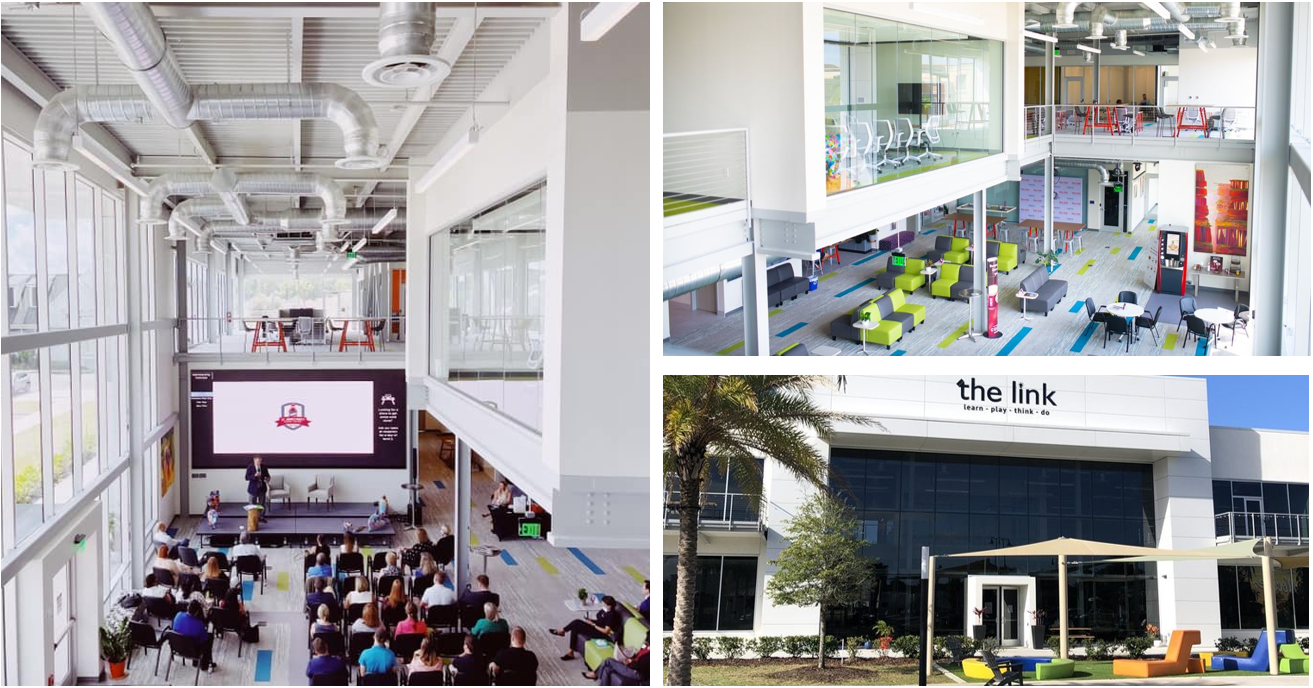
Hackathon Location
The Link is an environment that fosters creativity, productivity, and human development. It is a premier coworking and event space with dedicated and floating desks, community spaces, lounges, and meeting rooms with amenities like fast Wi-Fi. The Link is equipped with state-of-the-art technology, including an immersive studio and video conferencing equipment, and hosts regular events for professionals and families, all contributing to its reputation as a community hub for work and play. The Link has facilities for showering and refreshing for event attendees.
The Link offers flexible workspace solutions and a collaborative environment perfectly suited for generating and executing innovative ideas in a short timeframe.
The Link is located at 425 Town Plaza Ave, Ponte Vedra, FL 32081.
Competition Schedule
- 9 AM
- Datathon Kickoff, problem overview, and data sources review
- 9:30 AM
- Start digging in and research on why the problem is important? who does it affect? what are current solutions?
- 11 AM
- Analyze data and discover patterns, trends, and stories the data is telling. Find insights that are worth pursuing.
- 12:30 PM
- Lunch break. Step away from screens and mingle with other students to discuss the Big Ideas.
- 1:30 PM
- Brainstorm ideas for potential solutions to the problem utilizing the insights discovered in the morning.
- 3 PM
- Build prototypes for the solution.Middle schools consider developing interactive mockups. High schools consider developing working web apps.
- 5 PM
- Review and test the prototype.
- 5:30 PM
- Start preparing slides to translate data solution into a story that a judge can understand.
- 6 PM
- End of day 1. Continue working on the solution and preparing for the final presentation remotely.
- 10 AM
- Students arrive and prepare for the presentations.
- 10:30 AM
- Save all work and upload solution and presentation files to the event portal.
- 11 AM
- Final Tech Check. Ensure live demos work and slides are visually consistent.
- 12:30 PM
- Lunch break
- 1:30 PM
- Middle and High School Team Presentations.
- 3:30 PM
- Judges deliberation
- 4 PM
- Award ceremony
Saturday, March 28
Full day of coding and hacking remainder of the day and through the night
Sunday, March 29
Professional delivery and peer learning.
All times listed are in the Eastern Standard Time (EST).
Food and beverages will be provided during the event for participating students and accompanying teachers. Family members and friends of the participating students are welcome to attend the presentations and awards ceremony on Sunday, but they will not be able to participate in other scheduled activities. Only judging panel members will be allowed to ask questions during the presentations.
AI-Augmented Problem-Solving Framework
To tackle the complex community challenges presented in this datathon, we asked all participants to adopt this specific approach. It instructed students to combine human insight with artificial intelligence to deeply understand social issues, design targeted responses, and test innovative ideas.
Under this framework, we challenged students to partner with AI to quickly sift through complex datasets, reveal hidden patterns, and generate alternative options. However, we emphasized that their own human context, values, and local knowledge must guide the final decision-making process. This combination ensured that teams focused on building solutions to real-world challenges that were both data-driven and ethically grounded.
The 5 Stages of the Data4Good AI Challenge Journey
-
Research and Understanding: Diving into the core issues to uncover root causes.
-
Data Analysis: Interrogating the provided datasets to isolate key trends, anomalies, and disparities.
-
Brainstorming Solutions: Generating creative, alternative ideas to address the identified gaps.
-
Prototyping Solutions: Building out practical models or actionable intervention plans.
-
Presentations: Pitching their data-backed insights and final solutions to the panel of judges.
Our Core Rule: We explicitly reminded students that at every single stage of their journey, AI was to be used strictly as an assistant—not a replacement. Human empathy, ethics, and judgment were required to remain at the center of every project.
Recommended AI Tools
These tools are recommended because they are free, easy to use, browser-based, and do not require complex setups.
For Research & Understanding
- Perplexity AI: Best for middle/high school because it lists sources. Students can trust it more than a standard chatbot.
- Microsoft Copilot: Free GPT-4 access via browser. Great for summarizing long PDFs or articles.
For Data Analysis and Brainstorming
- Claude.ai: The free version has a very "human" way of explaining data files. Students can upload a CSV and ask, "What are the patterns here?"
- Google Gemini: Export data to a CSV or PDF. Upload it into Gemini and ask questions such as "What are the 3 biggest trends in this data?" or "Create a bar chart showing the correlation between X and Y."
For Prototyping
- Replit: Students can build, test, and host full-stack web applications and prototypes directly in their browser using an AI-powered coding agent.
- Figma: Students can transform simple text prompts into working app designs and functional prototypes, simplifying the transition from an initial idea to a visual product.
- Glide Apps: Students can create a mobile app prototype just by organizing a Google Sheet. No coding required.
- Canva Magic Media: For generating high-quality images of what their product would look like.
For Presentations
- Gamma.app: Students can type a few sentences about their project, and it generates a beautiful, multi-slide presentation in seconds.
- ChatGPT (Free Tier): Best for "Roasting" their pitch—they can paste their script and ask, "Act as a judge and find the flaws in my argument."
- NotebookLM: Automatically transforms dense research documents or rough notes into structured slide decks with speaker notes, allowing students to focus on their delivery rather than formatting.
Rules and Procedures
Eligibility:
- The competition is open to high school students in grades 6 through 12.
- Each team must consist of 2-3 students and must be registered by a coordinating teacher.
- All members of a team must be from same school.
- Multiple teams from the same school are welcome to participate. There is no cap on the number of teams from a school.
- Registration is free and the deadline is March 25.
Team Composition:
- Teams should be formed before the event. If any changes made to team structuring after competition begins, you will need to obtain permissions from Dr. Umapathy.
- Each team must have a designated team leader to communicate with mentors. All team members are encouraged to interact with the mentors and peers. All team members are encourage to participate in all datathon activities including presentation to judges.
- Teams should consist of a mix of members who excel in coding, problem-solving, and presenting to ensure a well-rounded approach to the competition.
Problem Cases and Datasets:
- Teams will be provided with a set of problem cases and relevant datasets at the beginning of the competition.
- Teams must select one problem case to work on and focus their efforts on solving it.
- Any external data used must be properly cited and documented.
Computer Usage:
- Participants must bring their own laptops to the event.
- Teams are expected to use their own computers to work on the problem case, analyze the dataset, and present their solutions.
- Organizers will not provide any computer device access during the competition.
- All software and tools required for the competition should be installed and tested on participants' computer devices before the event.
Mentoring:
- UNF School of Computing students will be mentoring participating students during the event.
- Mentors will be available at designated times to provide guidance and feedback on Saturday, March 28.
- Teams are encouraged to seek help and advice from mentors but must complete the work independently.
- Please feel free to ask for any clarification questions to event organizers during the event. We will answer your question as soon as we can.
Submission Requirements:
- Teams must prepare a presentation that includes their problem-solving strategy, solution approach, tasks performed, techniques used, and findings.
- Presentation and code repository files must be submitted by 9:30 AM on Sunday, March 29. Submission link will be provided during the event.
- Teams will be required to present their solutions on Sunday, March 29. Middle school teams will have 5 minutes to present. High school teams will have 7 minutes to present. The judges will listen to your presentation and review your solution to rank your team.
- Teams should also be prepared to answer questions from the judging panel during their presentation.
Code of Conduct:
- All participants must adhere to a high standard of honesty and integrity.
- Plagiarism and any form of cheating are strictly prohibited and will result in disqualification.
- AI chatbots such as ChatGPT, Gemini, and Claude are allowed during the event. However, you need to develop your unique solution, or else it will be considered an act of plagiarism, in which case, your team may be disqualified from the event.
- Participants are expected to treat each other, mentors, judges, and organizers with respect.
- Any disputes or issues that arise during the competition will be resolved by the organizing committee, and their decision will be final.
Datathon: Presentation Requirements
Final presentation should be a story of how teams tackled a complex problem. While AI tools are allowed, judging score depends on how students directed those tools to reach a meaningful solution.
Presentation must include the following sections:
The Problem: What specific real-world challenge was selected for this project? What is the significance of this problem on a local or global scale?
Data Analysis and Insights: What specific findings were derived from the dataset? What patterns, anomalies, or trends were identified during the analysis phase?
Human-AI Collaboration:
- Tool Selection: Which AI tools were utilized, and for what specific tasks?
- Methodology: How did the team direct the AI to achieve the desired outcomes?
- Verification: In what instances were AI-generated outputs evaluated, and what methods were used to verify their accuracy or identify potential biases?
The Solution: What is the proposed solution, and how does it function as a prototype? How does the design of this solution logically address the specific insights discovered in the data, and what evidence confirms its technical feasibility?
Social Impact and "So What?": What is the potential impact? What is the projected impact of this solution on the target population? What measurable improvements does this approach offer compared to existing solutions? Based on the data, what is the estimated scale of the population that could benefit from this intervention?
Future Scope: What are the technical and logical requirements to transition this project from a prototype to a real-world application? Given a hypothetical budget of $10,000 and a six-month timeline, what specific milestones and resources would be prioritized to implement this solution effectively?
Evaluation Criteria
Each participating team will be evaluated on their solution innovation and presentation of the results. Winners of the datathon will be determined based on the below evaluation factor weightings and scores received.
Critical Thinking (25%): Ability to explain why specific data features or AI methods were chosen. Evidence of verifying AI-generated facts/code for accuracy.
Innovation using AI Orchestration (25%): The Human-in-the-loop factor. How did students guide the AI? Did they spot AI errors? We are looking for students who "managed" the AI rather than just letting it do the work.
Strategic Solution Design (20%): Is the solution logical, creative, and feasible? Does it actually solve the problem presented, or is it just a "cool" piece of tech?
Social Impact (15%): Alignment with "AI for Good." How effectively does the solution address the specific needs of the affected population? Can the team articulate the real-world value? Do they have a clear vision for how this moves from a "project" to a "solution"?
Communication (15%): Clarity of the presentation, quality of visuals, and the team’s ability to handle Q&A from judges.
Scoring Ratings
For each category above, judges will rate the team on a Scale of 1–5, which is then multiplied by the weight.
5 = Excellent presentation on all counts
4 = Very good presentation with minor issues
3 = Pitch can be significantly improved but is satisfactory overall
2 = Pitch is incomplete and severely lacking
1 = Presenter fails to address the criteria
In the event of a tie in cumulative scores, judges will break the tie by awarding a bonues points. This preference is given to the team that most effectively used AI to accelerate their own original ideas, rather than relying on AI-generated suggestions, and demonstrated the highest level of critical thinking and skepticism toward AI outputs..
Awards and Prizes
Top-performing teams in both the Middle School and High School divisions would be recognized during the awards ceremony. Prizes will be awarded to each individual student within the winning teams.
Middle School Division:
- First Place: $100 per student
- Second Place: $50 per student
- Third Place: $25 per student
High School Division:
- First Place: $200 per student
- Second Place: $100 per student
- Third Place: $50 per student
Harness Data Insights
Dive into complex datasets and uncover groundbreaking discoveries.
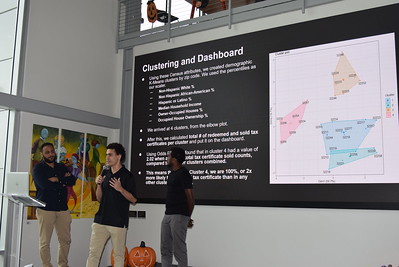
Tackle Real-World Challenges Together
Collaborate as a team to create data-driven and impactful solutions to pressing social issues.
Showcase Your Skills to Win Awards
Present your innovative solutions and compete for cash prizes.